
Your foundation repair website is getting visitors. Maybe your search rankings are improving, your Google Ads are bringing in traffic, or your website analytics show more activity than they did a few months ago.
That’s good news, right?
Not necessarily.
If those visitors aren’t picking up the phone, requesting an evaluation, or filling out your contact form, all that traffic may not be doing much for your bottom line.
For foundation repair and basement waterproofing contractors, website traffic is only valuable when it connects you with homeowners who may actually need your services.
The problem isn’t always getting people to your website. Sometimes, it’s what happens once they arrive.
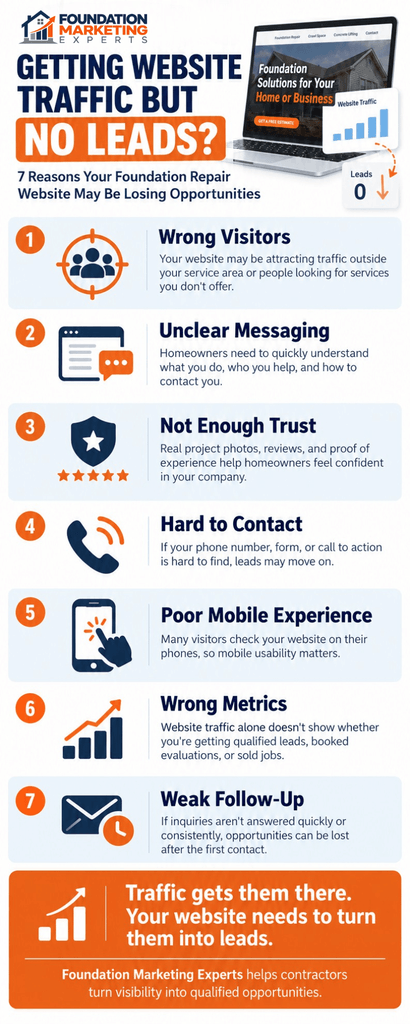
Let’s look at seven common reasons foundation repair websites fail to generate leads—and what you can do to fix them.
1. You’re Attracting Website Visitors, but Not the Right Ones
Not all website traffic is created equal.
Imagine your foundation repair company operates in eastern Iowa. Your blog about stair-step foundation cracks is attracting hundreds of visitors, but many are homeowners living in other states.
Your analytics might look impressive, but those visitors aren’t likely to become customers if they’re outside your service area.
The same problem happens when website content attracts people researching services you don’t offer.
For example, a contractor who specializes in helical piers and foundation stabilization might attract visitors looking for DIY concrete crack repairs. Those homeowners are searching for information, but they may not be ready—or interested—in hiring a foundation repair professional.
The Fix: Focus on Qualified Traffic, Not Just More Traffic
Your website’s SEO strategy should connect the services you actually offer with the homeowners you can realistically serve.
That means:
- Targeting relevant foundation repair and waterproofing searches in your service area.
- Creating pages dedicated to your primary services.
- Using the same language homeowners use when describing their problems.
- Making your service area easy to find.
- Reviewing which website pages attract visitors who eventually contact your company.
A visitor searching for “foundation repair contractor near me” may be closer to hiring than someone looking for general information about concrete cracks.
Both searches can be valuable, but they serve different purposes in the customer journey.
We’ve covered the importance of understanding homeowner search language in our article, Speak Their Language: Marketing Foundation Repair When Customers Don’t Know Your Terms.
Remember: More traffic doesn’t automatically mean more opportunities. The goal is attracting the right homeowners at the right time.
2. Your Website Doesn’t Clearly Explain What You Do
You understand the difference between push piers, helical piers, wall anchors, and carbon fiber reinforcement.
Most homeowners don’t.
They’re looking at a crack in their basement wall, a door that suddenly won’t close properly, or water collecting along their foundation.
Their first question probably isn’t, “Which underpinning system should I install?”
It’s more likely, “Can someone fix this?”
If your website immediately launches into technical descriptions of your products without first addressing the homeowner’s problem, visitors may struggle to understand whether your company can help.
The Fix: Lead With the Problem, Then Explain the Solution
Your website should guide homeowners from what they’re experiencing to the services that may address it.
For example:
Instead of leading with:
“Professional Installation of Helical Pier Systems”
Consider:
“Seeing Cracks or Signs of Foundation Settlement? We Can Help You Understand Your Repair Options.”
You can introduce helical piers, push piers, and other stabilization methods as visitors learn more about the services you provide.
This doesn’t mean eliminating technical information. It means presenting your expertise in a way that makes sense to someone unfamiliar with foundation repair.
Dedicated service pages are especially helpful here.
Someone researching a wet basement should be able to find information about waterproofing without sorting through several paragraphs about foundation underpinning.
Likewise, someone concerned about a bowing basement wall should quickly find information relevant to wall stabilization—not have to search through a general services page.
The easier it is for homeowners to recognize their problem on your website, the easier it becomes for them to take the next step.
3. Your Website Isn’t Giving Homeowners Enough Reasons to Trust You
Foundation repair isn’t an impulse purchase.
Homeowners may be worried about the safety of their homes, the potential cost of repairs, and whether they’re making the right decision.
They’re often comparing several contractors before scheduling an evaluation.
Your website needs to do more than explain what you offer. It also needs to give visitors confidence in your business.
A website with generic stock photography, vague promises, and little evidence of completed work can make that decision harder.
The Fix: Show Homeowners the People and Work Behind Your Business
Build credibility with information and visuals that demonstrate your actual experience.
Consider including:
- Real project photos: Show foundation stabilization, wall repair, basement waterproofing, and other work your crews have completed.
- Before-and-after examples: Help homeowners visualize the results of your services, with accurate descriptions of what was done.
- Customer reviews and testimonials: Share genuine feedback from people who have worked with your company.
- Crew and team photos: Introduce the professionals homeowners may meet during their evaluation or repair.
- Credentials and experience: Highlight relevant licenses, certifications, industry training, warranties, and company history where applicable.
- Project explanations: Describe the homeowner’s original concern, the recommended solution, and the work performed.
For example, a project feature about a bowing basement wall can explain the signs the homeowner noticed, the evaluation process, and the type of stabilization system installed.
That’s more meaningful than simply stating, “We offer quality foundation repairs.”
Whenever possible, use actual project photography and explanations provided or reviewed by your team.
Your experience is one of your strongest marketing advantages. Make sure your website demonstrates it.
4. You’re Making It Too Difficult to Contact Your Company
Imagine a homeowner discovers a horizontal crack in their basement wall.
They search for a foundation repair contractor, find your website, and start reading about your services.
They’re interested in scheduling an evaluation.
But your phone number is difficult to find, your contact form asks too many questions, or the only call-to-action button is buried at the bottom of a long page.
What happens next?
They may leave and contact another company.
Even a well-designed website can lose potential customers when the next step isn’t obvious.
The Fix: Make Contacting You Simple
Every important service page should provide a clear, convenient way to reach your business.
That might include:
- A visible, click-to-call phone number on mobile devices.
- A clear “Request an Evaluation” or “Schedule a Consultation” button.
- A short, easy-to-complete contact form.
- Contact options placed near relevant service information.
- A straightforward explanation of what happens after someone submits an inquiry.
Consider the wording of your calls to action, too.
“Submit” doesn’t tell homeowners much.
“Request a Foundation Evaluation” gives them a clearer idea of what they’re doing.
And if your company offers free evaluations, make that clear. If there are fees or other qualifications, explain those honestly.
Don’t forget to test your contact forms and phone links regularly. A broken form or incorrect phone number can quietly cost your business opportunities.
The goal isn’t to pressure homeowners into contacting you. It’s to remove unnecessary obstacles when they’re ready.
5. Your Website Looks Good on a Computer but Struggles on Mobile
A homeowner notices water along their basement wall after a heavy rain.
They pull out their phone and search for waterproofing companies in their area.
Your website appears in the results, and they click.
Unfortunately, the page takes too long to load. The text is difficult to read, images push important information off the screen, or the contact button is nearly impossible to tap.
That homeowner may never see the information you worked so hard to provide.
Mobile usability matters because your customers aren’t always sitting at a desk when they discover a problem.
The Fix: Experience Your Website the Way a Homeowner Would
Open your website on your own phone and ask:
- Does the page load without unnecessary delays?
- Can I immediately tell what this company does?
- Is the text easy to read without zooming?
- Can I find the phone number and contact button?
- Are service pages easy to navigate?
- Can I submit a contact form without frustration?
Pay special attention to your most important pages, including foundation repair, basement waterproofing, crawl space services, and your contact page.
Large images, excessive scripts, intrusive pop-ups, and confusing navigation can all interfere with the mobile experience.
A mobile-friendly website isn’t simply a smaller version of your desktop website. It should make finding information and contacting your company easy, regardless of screen size.
6. You’re Measuring Website Traffic Instead of Actual Leads
Here’s a question worth asking:
Do you know which pages on your website are generating actual customer inquiries?
Many contractors can tell you how many people visited their website last month.
Far fewer can confidently explain how many of those visitors called, submitted a form, scheduled an evaluation, or eventually became paying customers.
Those are very different measurements.
A blog post might attract a large audience without producing many immediate inquiries.
Meanwhile, a basement wall repair service page might receive fewer visits but generate several qualified calls.
Looking at traffic alone can make the less valuable page appear more successful.
The Fix: Track the Actions That Matter to Your Business
Start connecting your website activity with actual customer inquiries.
Useful measurements include:
| Metric | What It Tells You |
|---|---|
| Website visits | How much traffic your website receives |
| Traffic sources | Where visitors are coming from |
| Form submissions | How many visitors request information online |
| Phone inquiries | How many calls your marketing generates, when properly tracked |
| Qualified leads | How many inquiries are relevant to your services and service area |
| Booked evaluations | How many inquiries become appointments |
| Sold jobs | How many opportunities result in completed sales |
Tools such as Google Analytics 4 and properly configured call tracking can help you understand how visitors interact with your website.
But the information becomes even more valuable when connected to your company’s customer management or sales records.
For example, if your waterproofing page generates ten inquiries, how many are homeowners in your service area? How many schedule evaluations? How many ultimately hire your company?
Those answers help reveal whether your marketing is attracting the right audience—and where potential customers may be dropping out of the process.
Tracking doesn’t need to be complicated to be useful. Start with reliable measurements, then refine your reporting as you learn more.
The goal isn’t simply more website traffic. It’s more qualified opportunities that can turn into real business.
7. Your Website Generates Inquiries, but Your Follow-Up Process Loses Them
Sometimes the website isn’t the biggest problem.
Your contact form works. Homeowners are calling. Your marketing campaigns are generating inquiries.
But those inquiries aren’t turning into scheduled evaluations or signed jobs.
That’s when it’s time to look beyond website traffic.
A homeowner dealing with foundation settlement or water intrusion may contact multiple contractors while researching solutions.
If their inquiry goes unanswered, their voicemail isn’t returned, or they aren’t sure what happens next, they may continue their search.
The Fix: Connect Your Website to a Reliable Lead Follow-Up Process
Review what happens after someone contacts your company.
- Who receives website form submissions?
- How quickly are inquiries reviewed and answered?
- Are missed calls followed up?
- Do homeowners receive confirmation that their request was received?
- Does your team have a consistent process for scheduling evaluations?
- Are inquiries tracked through the estimating and sales process?
Consider using automated inquiry confirmations, call tracking, and a customer relationship management (CRM) system where appropriate.
Automation can help organize communication, but it shouldn’t replace the personal attention homeowners expect when considering a major repair.
Your website and your team should work together.
After all, generating a qualified inquiry is only one part of winning a new customer.
A Quick Website Checkup for Foundation Repair Contractors
Not sure where your website may be losing leads?
Start with these seven questions:
- Relevance: Are we attracting homeowners who need services we actually provide in our service area?
- Clarity: Can visitors immediately understand what problems we solve?
- Trust: Does our website show real projects, customer feedback, and relevant experience?
- Accessibility: Is it easy to call us or request an evaluation?
- Mobile usability: Can homeowners comfortably navigate and contact us from their phones?
- Measurement: Do we know which pages and marketing channels produce qualified inquiries?
- Follow-up: Do we have a reliable process for turning those inquiries into appointments and jobs?
If you answered “no” or “I’m not sure” to several of these questions, your website may have opportunities for improvement.
That doesn’t necessarily mean you need an entirely new website.
Sometimes, clearer messaging, better service pages, stronger project photography, improved calls to action, or more reliable lead tracking can make a meaningful difference.
The important thing is identifying the actual problem before investing in a solution.
Frequently Asked Questions About Foundation Repair Website Leads
Several issues could be responsible, including irrelevant traffic, unclear service information, limited trust-building content, poor mobile usability, or contact options that are difficult to find.
Start by reviewing where visitors come from, which pages they visit, and whether your phone and form tracking are functioning correctly.
Make it easy for homeowners to understand your services, recognize their problems, trust your experience, and contact your company.
Clear service pages, real project photography, visible contact options, mobile-friendly design, and accurate lead tracking can all contribute to a better customer experience.
Dedicated pages are often useful when services address different homeowner needs.
For example, foundation settlement, basement waterproofing, bowing wall repair, and crawl space encapsulation involve different concerns and potential solutions.
Separate, useful pages allow you to answer relevant questions in greater detail and guide homeowners toward the appropriate next step
Avoid creating nearly identical pages solely to target additional keywords.
Look beyond website visits and form submission totals.
Track whether inquiries come from homeowners in your service area, whether they need services you offer, and whether those inquiries result in scheduled evaluations and signed jobs.
Connecting website analytics with call tracking and sales records provides a clearer picture of marketing performance.
That depends on where the problem occurs.
If your website isn’t appearing for relevant searches, SEO may deserve greater attention.
If you’re already attracting qualified visitors but few contact your company, improving website messaging, usability, and conversion paths may be the better starting point.
For many contractors, SEO and website improvements work best as part of a coordinated strategy.
Your Website Should Do More Than Attract Visitors
Getting homeowners to your website is an important first step.
But attracting attention and generating business aren’t the same thing.
Your website should help homeowners recognize their problems, understand your services, feel confident in your company, and take the next step toward getting help.
When those pieces work together, your website becomes more than an online brochure. It becomes a valuable part of your lead-generation and sales process.
At Foundation Marketing Experts, backed by Team WTI, we understand that foundation repair and waterproofing contractors have different marketing challenges than many other businesses.
We help contractors connect their SEO and search visibility with websites designed to turn visitors into inquiries.
Getting traffic but not enough qualified leads?
Let’s take a closer look at your website and find out where opportunities may be getting lost.
